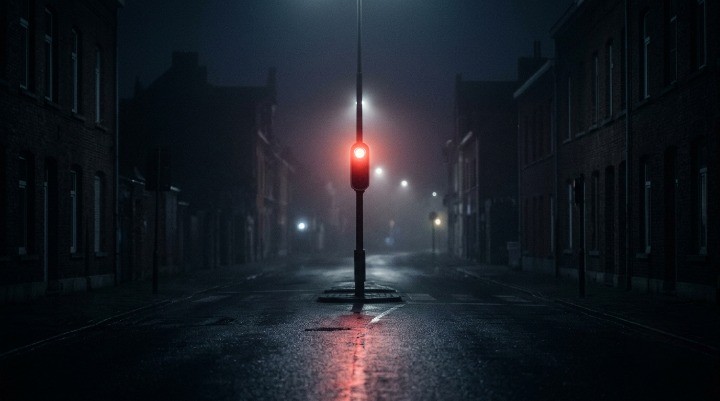
As night deepens, so do our thoughts.
The moment the busy rhythm of the day comes to a halt, memories and emotions that went unprocessed begin to quietly surface. Did something I said today leave the other person feeling uncomfortable? Will I manage to handle tomorrow’s demands? What if I had chosen differently back then?—these thoughts, each one pulling the next behind it, fill the mind in the small hours of the night.
Even with eyes closed, the brain keeps running. The body lies still, yet the mind races restlessly somewhere far away—the heavy, isolating friction of a night spent exhausted, longing for a rest that refuses to arrive.
Having Many Thoughts Means You Are Receiving the World with That Much More Sensitivity
People sometimes say: “Why do you make things so complicated? Just go to sleep.”
It isn’t wrong advice. But for someone whose mind refuses to quiet down, the sheer effort required to simply fall asleep—the fatigue of it—is not easily understood by those who have never experienced it.
To have many thoughts is also to be attuned to the stimuli around you. These are people who cannot simply let the world pass through them; they absorb others’ emotions with care, and assign meaning to every minor event of daily life. As a result, the volume of data they must process throughout the day is considerably greater than most.
The difficulty is that this sensitivity loses its direction come nightfall. During the day, external stimulation keeps thoughts dispersed; but when everything around you grows quiet, all of those perceptions turn inward. That is why the thoughts of night feel especially sharp—amplified beyond their daytime weight.
If your thoughts multiply every night, that is not something wrong with you. It simply means you are engaging deeply with the world, taking it seriously.
You Don’t Owe a Response to Every Thought That Arrives
We tend, habitually, to react to every thought that surfaces in our minds. “What should I do about this?” “Why did I say that?”—one thought arrives, we seize it and try to resolve it, and in doing so fall into an infinite loop that only leads to the next worry.
But it is worth stepping back and asking honestly:
Does wrestling with that concern at midnight actually change anything? Right now, in this moment, most of the things you are turning over in your mind cannot be altered, regardless of how long you deliberate.
Not every thought is an assignment due immediately. Some thoughts are perfectly fine to let drift by. The worries that resist resolution are better delegated to a clearer, fresher mind—the one you’ll have in the morning.
You are not obligated to open the door every time a thought comes knocking. It is enough to say, quietly, “This is not the time for an answer,” and ease the door shut.
Installing a Signal System Inside the Mind
When thoughts come flooding in beyond control, I sometimes imagine setting up a small traffic signal system inside my head.
A red light flashes: Stop.
“This thought ends here. The rest, I delegate to my morning self.”
At first, this kind of control doesn’t hold well. Thoughts are not switches you can turn off and on at will. But with deliberate repetition, the signal gradually begins to function.
What matters is not forcing thoughts into suppression, but interrupting their flow—placing them on hold. Not “this thought is wrong,” but “this thought is not for now.” Suppression breeds resistance, whereas delegating to time provides the mind with a quiet, legitimate reason to set the thought down.
As you apply this red light to each thread of thought, one by one, a gap begins to open in what was once a cluttered mind. Not perfect silence, but something like a pause—a margin in which to draw a single breath. That margin is precisely the space we need most in the late hours of the night.
For Tonight, You Can Afford to Trust Tomorrow’s You
We try to hold too many problems at once—right now, by ourselves.
The unresolved, the future not yet arrived, the past already gone—we open all of them on the same screen at once and try to process them simultaneously, as though failing to find an answer tonight would bring immediate catastrophe.
But lying awake tonight will not solve tomorrow’s problems. It will only deliver you into tomorrow already depleted, your clarity already dimmed.
The self you will be tomorrow is capable of better judgment than the self you are tonight. With clearer eyes and a calmer mind, you will be able to look at these same unresolved things from a different angle. So for now, trust the judgment that tomorrow will bring. Tonight, it is perfectly fine to power down the screen for a while.
Having many thoughts is neither a weakness nor an aberration. It is simply the mind catching its breath after spending too much energy throughout the day.
Tonight, if the thoughts come flooding in, try closing your eyes, breathing slowly and deeply, and making this quiet declaration to yourself:
“This thought ends here. What remains, I leave to my morning self.”
That single sentence will switch on a momentary red light in the complex circuitry of your mind.
And tomorrow morning, when you open the window and look up at a bright sky, the worries that consumed last night may feel considerably smaller than you expected. Thoughts in the dark tend to run larger than life. In the light of day, every problem becomes a little clearer—and a little easier to hold with steadiness.